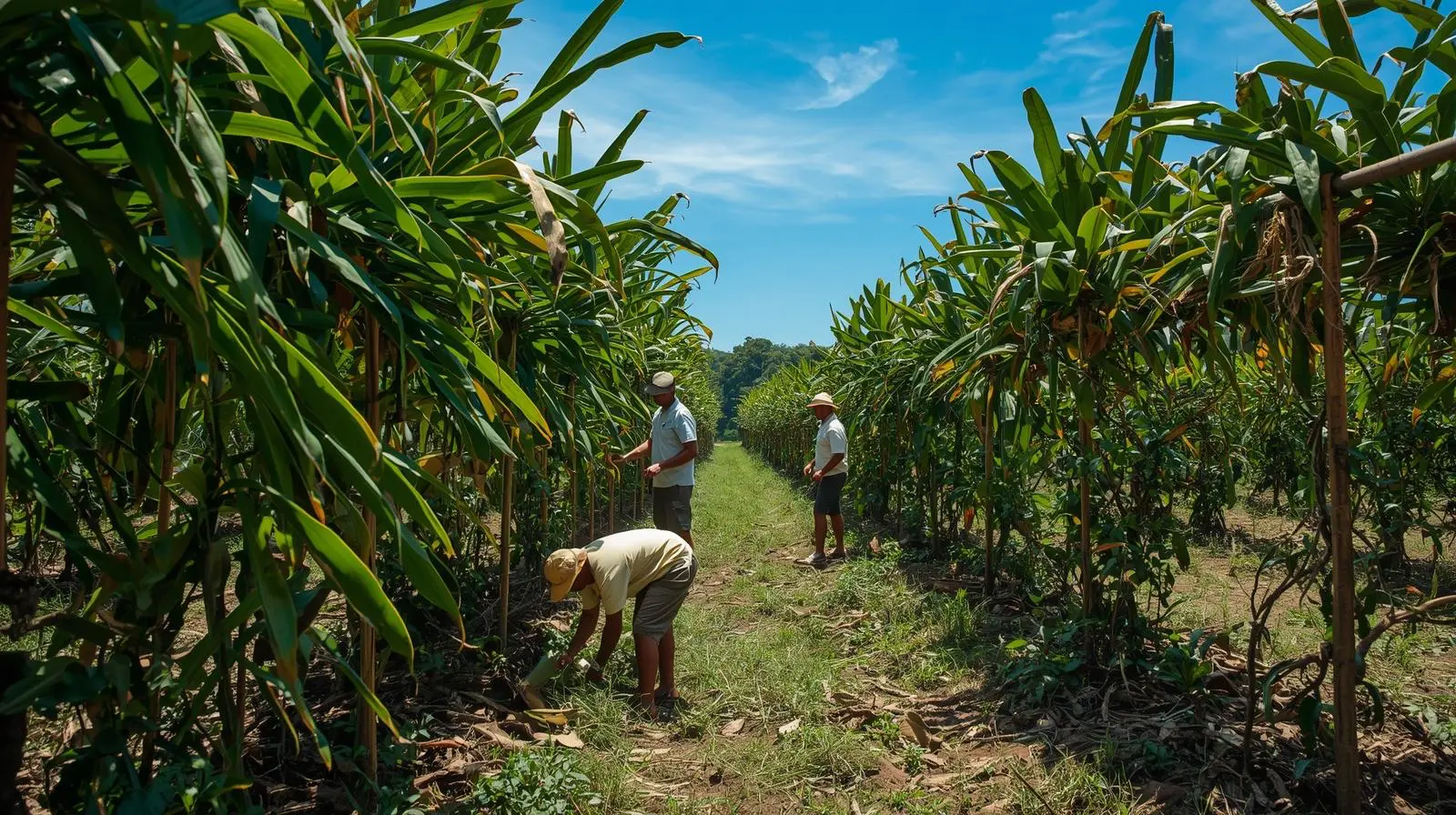
Why is Madagascar vanilla the most prized in the world?
Madagascar vanilla now accounts for over 80% of the world’s natural vanilla production. This dominance is no accident: it’s the result of an ideal tropical climate, artisanal know-how passed down through generations, and a botanical species of incomparable aromatic richness, Vanilla planifolia.
Nicknamed the « queen of spices », Madagascar Bourbon vanilla stands out for its natural vanillin content, its softness, its dark brown colour and its warm notes of cream, butter and blond tobacco. It’s this aromatic complexity that makes it the flagship ingredient of professional and artisanal baking worldwide.
The history of vanilla in Madagascar
Vanilla originates from Mexico, where the Aztecs used it to flavour xocoatl, their cacao drink. The Spanish introduced it to Europe in the 16th century, but for a long time the plant would not reproduce outside its natural habitat, lacking its natural pollinator, a bee endemic to Mexico.
Everything changed in 1841, when Edmond Albius, a 12-year-old enslaved boy from Réunion, discovered the technique of hand-pollinating the vanilla flower. This discovery revolutionised vanilla growing worldwide and enabled its development across the islands of the Indian Ocean. Madagascar quickly adopted the crop, and the SAVA region — for Sambava, Antalaha, Vohemar and Andapa — became the cradle of Malagasy Bourbon vanilla.
Today, thousands of Malagasy farming families depend on vanilla growing, carrying on an agricultural heritage unique in the world.
Vanilla varieties grown in Madagascar
Vanilla planifolia: classic Bourbon vanilla
This is the variety most widely grown in Madagascar. Its long, plump, glossy pods offer an exceptional vanillin content (up to 2.5%). It forms the basis of the vast majority of our Grade A and Grade Premium vanilla pods.
Vanilla tahitensis: Tahitian-type vanilla
Rarer, Tahitian-type vanilla is grown in small quantities in Madagascar. Its shorter, wider pods develop floral notes of heliotrope and aniseed, very different from planifolia. It’s especially prized in fine dining for its original aromatic profile. Discover our Tahitian-type Grade Premium 18 cm+.
Vanilla pompona: black pompona vanilla
Pompona vanilla, sometimes called « fat vanilla », produces short, stocky pods, very rich in aromatic matter. Its flavour profile stands out with notes of candied fruit and tobacco. Our Pompona Grade A 16-19 cm is ideal for long-infusion preparations.
How is Madagascar vanilla produced?
Malagasy vanilla production is entirely manual, from pollination to final curing:
- Hand pollination — Each flower is pollinated by hand on the very day it opens (it only stays open for a few hours). This is meticulous, demanding daily work.
- Harvesting the green pods — After 9 months of growth, the pods are harvested while still green, with no apparent scent.
- Blanching — The pods are dipped for 3 minutes in water at 65°C to stop vegetative growth and trigger the enzymatic reactions that produce vanillin.
- Sweating — Wrapped in wool blankets, the pods ferment for 48 hours in airtight crates.
- Slow drying — Laid out in the sun by day and brought in at night, the pods dry for 2 to 6 months until reaching their characteristic dark brown colour.
- Curing — The pods are stored in trunks for several months to develop their final aromatic bouquet.
This artisanal process, spanning 10 to 12 months, explains the price of quality natural vanilla — and fully justifies its status as a luxury product.
Madagascar vanilla grades
At My Spices Land, we offer several grades to suit every use:
- Grade A (Gourmet): soft, glossy pods with high moisture content (25-30%). Ideal for scraping seeds in baking. Available in 13-15 cm, 10-12 cm, and in a lower grade for large-scale preparations.
- Grade Premium: the pinnacle of quality. Long pods of 18-20 cm and 20 cm and above, ultra-plump, reserved for pastry chefs and fine food shops.
- Derived products: pure vanilla seeds, Grade A vanilla powder and vanilla caviar for professionals.
FAQ — Madagascar vanilla
What’s the difference between Madagascar vanilla and synthetic vanilla?
Synthetic vanillin is produced from petroleum derivatives or wood cellulose. It reproduces a single aromatic compound, where natural vanilla contains over 250. The taste is fundamentally different: flat and one-dimensional for the synthetic version, complex and deep for the natural one.
How many vanilla pods does a recipe need?
As a rule of thumb: 1 pod per 500 ml of liquid (custard, ice cream, crème brûlée) or per 500 g of batter (financier, cake). With Grade Premium, half a pod is often enough thanks to its aromatic richness.
Does Madagascar vanilla keep for a long time?
Yes. Under good conditions (airtight tube, away from light, between 15°C and 20°C), Grade A pods keep their aroma for 18 to 24 months. See our vanilla storage guide.
Buy real Madagascar vanilla
At My Spices Land, we work directly with Malagasy producers in the SAVA region, guaranteeing full traceability and consistent quality. All our products are packed to order to ensure maximum freshness.
Laisser un commentaire